
Two Distinct Rules for Total Elevator Safety

When designing a residential elevator in Ontario, homeowners and builders must strictly adhere to two entirely separate but equally critical safety mandates under CSA B44 codes. First, you must use solid core doors. This has nothing to do with the gap space; it is because hollow core doors lack the structural integrity to securely anchor the certified electromechanical interlocks required to keep the door safely locked when the cab is not present. Second, you must adhere to the ¾” × 4” rule, which dictates the allowable space between the landing door and the elevator cab to prevent child entrapment. To achieve this tight clearance without ruining your home's architectural millwork, Sabre Elevator provides Clear Polycarbonate Door Baffles.
When planning a custom build in the Waterloo Region or the GTA, it is incredibly common for a builder to order standard interior doors for the elevator landings. If those are standard hollow-core bedroom doors, your installation is going to fail its safety inspection immediately.
There is often confusion around why certain doors and gaps are mandated. In the residential elevator industry, landing door safety comes down to two distinct rules that serve entirely different purposes: securing the lock, and eliminating the entrapment gap.
Here is exactly why each rule exists and how to ensure your home is fully compliant.
1: Why You Absolutely Need Solid Core Doors
The mandate for solid core doors has nothing to do with the physical space behind the door. It is entirely about the door's structural ability to safely hold an electromechanical lock.
This isn't just a strong recommendation; it is the law. The requirement for solid core (or reinforced) swing doors in private residence elevators became officially enshrined in the code primarily through the ASME A17.1/CSA B44-2016 revision, which was published on November 30, 2016.
An elevator landing door is a critical safety barrier guarding a multi-story hoistway. To keep that door securely shut when the elevator cab is on another floor, it must be fitted with a certified electromechanical interlock. If you attempt to mount this certified hardware onto a hollow-core door—which is essentially a thin wood veneer wrapped around air and cardboard honeycomb—the screws will eventually rip right out of the wood. Furthermore, hollow doors flex. If someone leans against a hollow door, the centre can bow significantly, potentially defeating the lock mechanism entirely. A solid core door is non-negotiable because it provides the rigid, dense structural integrity required to securely anchor the interlock for decades of daily use.
2: The ¾” × 4” Rule
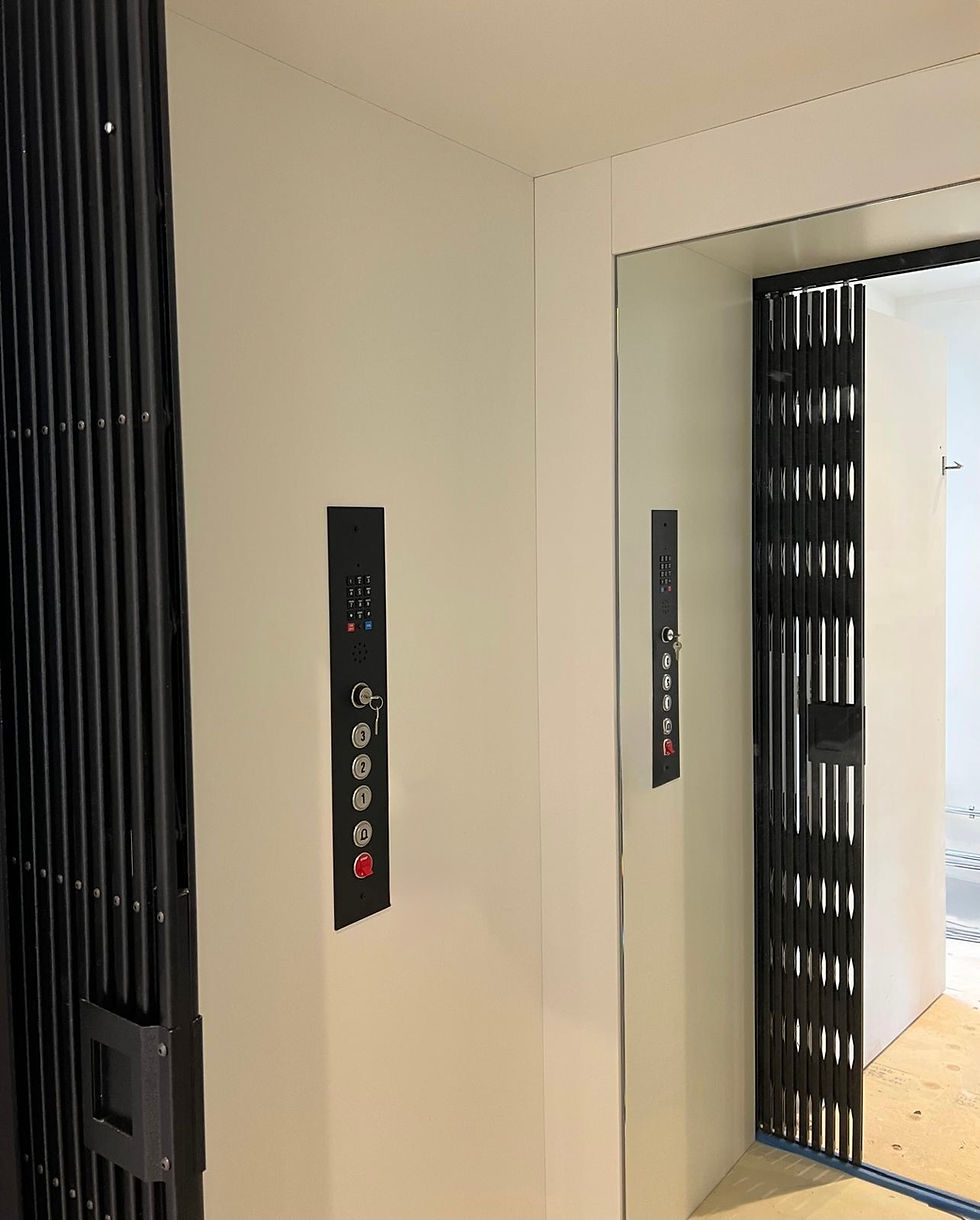
The second safety pillar is the ¾” × 4” rule, also mandated by the ASME A17.1 / CSA B44 safety code. This rule specifically addresses the physical gap between the back of your closed hallway door and the folding door (or gate) of the elevator cab itself.
Historically, if this gap was too large, a small child could open the hallway door, step into the space on the sill, pull the hallway door shut behind them, and become trapped between the landing door and the moving elevator cab. To completely eliminate this risk, the code mandates:
The distance from the back of the swing door to the landing sill edge can be no more than ¾ of an inch.
The total space between the two closed doors must reject a 4-inch sphere at all points.
The Sabre Baffle Solution
Achieving exactly ¾ of an inch of clearance behind a solid core door requires incredibly precise architectural framing. Sometimes, due to standard construction variations or when retrofitting an older home, the gap ends up being slightly too large.
Instead of tearing out the door frame or nailing an ugly piece of painted plywood to the back of the door to fill the space, Sabre Elevator uses Clear Polycarbonate Door Baffles.
These baffles are securely mounted to the back of your solid core door to safely reduce the clearance to code-compliant levels. Because they are clear, they blend seamlessly into the background, ensuring your home's custom architectural millwork remains the focal point.

Frequently Asked Questions: Home Elevator Door Safety
Why are solid core doors legally required for residential elevators in Ontario? Mandated primarily through the ASME A17.1/CSA B44-2016 safety code revision, solid core (or reinforced) doors are strictly required because they provide the necessary structural density. Elevator landing doors must be fitted with heavy, certified electromechanical interlocks. Hollow-core doors lack the interior structure to securely anchor this hardware and will flex under pressure, which can cause the locking mechanism to fail.
What is the ¾” × 4” child entrapment rule? This is a critical safety standard under the CSA B44 code designed to prevent a child from becoming trapped between the landing door and the elevator cab door. It mandates two things: the gap from the back of the closed hallway door to the landing sill edge cannot exceed ¾ of an inch, and the total space between the two closed doors must reject a 4-inch sphere at all points.
Can I use a standard hollow-core bedroom door for my elevator? No. If a hollow-core door is installed at an elevator landing, the installation will immediately fail its safety inspection. They do not meet the structural requirements for holding certified interlock hardware and pose a severe safety hazard.
How do clear polycarbonate door baffles work? If the framing of your home leaves a gap larger than the mandated ¾ of an inch, we install Clear Polycarbonate Door Baffles to the back of your solid core landing doors. These baffles safely reduce the excess space to meet strict code requirements. Because they are clear, they do not ruin the look of your home's custom architectural trim.

Comments